
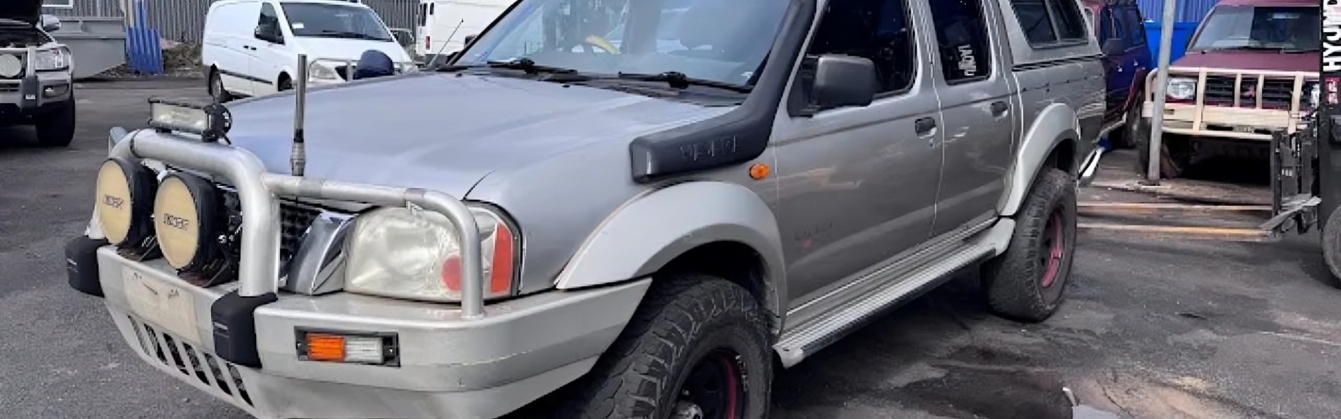
A 4WD that suddenly refuses to start can leave you wondering what to do next. The problem could be as simple as a flat battery, or it could be a sign of a much bigger mechanical issue.
If your 4WD has been sitting in the driveway for months, has suffered accident damage, or has already had several expensive repairs, it is worth looking at the bigger picture before spending more money.
Here are some practical steps to help you decide what to do with a 4WD that will not start.
Start With the Simple Things
Before assuming the engine has a major fault, check the basics.
Turn the key or press the start button and pay attention to what happens.
If you hear clicking but the engine does not turn over, the battery could be flat or weak. If there is no response at all, check the battery connections and look for obvious electrical problems.
You should also check:
- Whether there is enough fuel
- Battery terminals for corrosion
- Warning lights on the dashboard
- Loose or damaged wiring
- Obvious fluid leaks
- Damaged belts or hoses
If you are not comfortable checking these things yourself, it is safer to have a mechanic inspect the vehicle.
Has the 4WD Been Sitting for a Long Time?
A 4WD that has been parked for a few weeks may only need a battery charge.
A 4WD that has been sitting unused for years is a different story.
Long periods without use can affect the battery, tyres, brakes, fluids and fuel system. Wiring can also be damaged by rodents, particularly when a vehicle has been left outside or in an unused garage.
For this reason, avoid simply jump-starting an old 4WD and driving it away without checking its condition first.
Find Out What the Repair Will Cost
If the easy fixes do not work, get a proper diagnosis.
A mechanic may find that the problem is relatively small. But if the engine, transmission, fuel system or electrical system needs major work, the bill can become expensive quickly.
Before approving a major repair, ask yourself:
How much is the repair going to cost, and what will the 4WD be worth afterwards?
That question becomes even more important when the vehicle is already old, damaged or in poor condition.
Look at the Whole Vehicle, Not Just the Starting Problem
It is easy to focus on the fact that the 4WD will not start. But the starting problem may not be the only issue.
Take a realistic look at the vehicle’s overall condition.
Consider:
- The age and kilometres
- Engine and transmission condition
- Accident or body damage
- Rust
- Tyres and suspension
- Interior condition
- Registration status
- Previous repair costs
- Any other faults you already know about
For example, replacing a battery on an otherwise well-maintained 4WD may be an easy decision.
On the other hand, spending thousands on an old 4WD that also needs tyres, suspension, body repairs and engine work may not make much sense.
What If the 4WD Is Not Worth Repairing?
This is where many owners get stuck.
They have a 4WD sitting at home that does not run, but they keep putting off the decision because they do not know what to do with it.
You do not necessarily have to repair a non-running 4WD before selling it.
Even when a 4WD cannot be driven, it may still have useful components. Depending on the vehicle, parts such as the engine, gearbox, wheels, body panels, interior components and other mechanical parts may have value.
At Cash For 4WD Hub, non-running vehicles are among the types of 4WDs the business accepts, so the vehicle does not have to be in working order before you ask for an assessment.
If you are considering this option, you can see how the cash for 4WD service in Perth works before deciding what to do.
Don’t Forget About the Cost of Keeping It
An unwanted 4WD can cost you money even when it is sitting still.
Depending on your situation, you may still be dealing with:
- Storage space
- Registration
- Insurance
- Ongoing repairs
- Battery replacement
- Tyre deterioration
- The cost of moving the vehicle
There is also the simple problem of having a large vehicle taking up space on your property.
If you already know that you are unlikely to repair or use it again, keeping it for another year may not solve the problem.
What If the 4WD Cannot Be Driven?
A non-running 4WD does not have to be driven to its next destination.
Vehicle removal equipment can be used to collect 4WDs that cannot start or move under their own power. This can be particularly useful for vehicles with serious mechanical problems, accident damage or long-term storage issues.
Before arranging collection, be honest about the condition of the vehicle.
Tell the buyer if:
- The engine does not start
- The wheels are damaged or missing
- The vehicle has no keys
- It has major accident damage
- It is difficult to access
- It has been sitting for a long time
Giving these details beforehand helps the removal team plan for the right equipment.
If you need help moving a non-running vehicle, you can also learn more about the 4WD removal service in Perth.
Should You Repair, Sell or Recycle It?
There is no single answer for every 4WD.
A newer 4WD with a small mechanical problem may be worth repairing.
An older vehicle with major engine damage, accident damage and several other faults may be a different story.
The best choice usually comes down to the vehicle’s condition and the cost involved.
A simple way to think about it is:
Small repair + good overall condition = repair may make sense.
Major repair + several existing problems = compare the cost with other options.
Severely damaged or end-of-life 4WD = selling for parts or recycling may be more practical.
Don’t Rush Into an Expensive Repair
A 4WD that will not start can make you feel like you have very few choices. In reality, you have several.
Start with the simple checks. If they do not solve the problem, get a proper diagnosis and find out what the repair is likely to cost.
Then look at the vehicle as a whole.
If the 4WD is still in good shape, repairing it may be worthwhile. If it is old, damaged and facing a large repair bill, it may be time to consider selling it instead.
The important thing is to make the decision based on the vehicle’s actual condition rather than continuing to spend money on a 4WD simply because you have already spent money on it.
Should I repair or sell my non-running 4WD?
Compare the repair cost with the vehicle’s age, condition and likely value after repairs. If several major repairs are needed, selling the vehicle may be a more practical option.